
Table of Contents
Industry (Means of production)
Introduction
OASIS contains its own Industry system, a community-driven process to own and operate the means of production collectively inside the social network.
Instead of private companies, Industry prioritises shared ownership, libre recipes, and contributions that can be measured and rewarded.
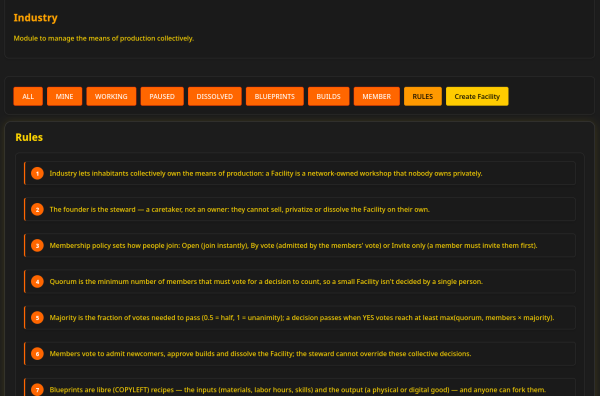
The Industry module lets people found Facilities (network-owned workshops), publish Blueprints (copyleft recipes), approve Builds (production orders), contribute labour, materials or ECOin, and keep a transparent record of everything that happens: who decided what, who produced what, and how the result was distributed.
Facilities
A Facility is a workshop that belongs to the network, not to a person. It is the unit that holds members, blueprints, builds and decisions.
When you create a Facility you define:
- Name and Description — what this facility produces.
- Sector — Software, Hardware, Agriculture, Textile, Energy, Food, Construction, Media, Services or Other.
- Membership policy — how new people get in (see below).
- Quorum and Majority — how collective decisions are passed.
- Labour rate — the ECOin value of one work hour inside this facility.
The founder becomes the steward: a caretaker, not an owner. The steward keeps the facility data up to date and executes what the members decide, but cannot sell it, privatise it or dissolve it alone.
Facility status
- WORKING – The facility is active: builds can be proposed, approved and contributed to.
- PAUSED – The members have voted to pause activity. The record stays visible, but production is frozen.
- DISSOLVED – The members have voted to dissolve the facility. It becomes part of the history of the network.
Pausing, resuming and dissolving are collective votes, never a decision of the steward.
Membership
When opening a Facility you choose a Membership policy. It defines how somebody becomes a member and starts contributing:
Open
Anyone can join instantly, with no approval step. Use this for facilities that want the widest possible participation and are not worried about who walks in.
By vote
People send a request to join and the current members vote to admit them. Use this when trust matters and the group wants to decide together who is part of the commons.
Invite only
A member must invite somebody before they can join. Use this for small or sensitive workshops, or when membership grows through personal trust.
Members can leave whenever they want. Leaving is not a punishment, but it has a consequence: only the contributions of current members are counted, so leaving a facility drops your shares in it. The rule is the same for votes — you decide while you are inside.
Governance and voting
Every collective decision in Industry uses the same threshold, built from two numbers of the facility:
- Quorum – The minimum number of members that must support a decision, so a small facility is not decided by a single person.
- Majority – The fraction of members needed to pass (0.5 = half, 1 = unanimity).
A decision passes when the YES votes reach at least max(quorum, members × majority).
The following actions are decided by vote:
- Admitting a new member (in facilities with the By vote policy).
- Pausing or resuming the facility.
- Dissolving the facility.
- Approving or rejecting a build.
- Updating or deleting a blueprint.
- Updating or deleting a build.
Two details worth knowing:
- Votes are reversible. Only your latest preference counts, so you can change your mind while the decision is still open.
- A vote authorises; the author executes. Because every message in OASIS is signed by the person who wrote it, an approved deletion or edit is carried out by the author of that blueprint or build, not by somebody else on their behalf.
When the steward is still alone in the facility, there is nobody to vote with: they act directly. As soon as there are more members, the vote is required.
Blueprints
A Blueprint is a recipe: what goes in, and how much work it takes.
- Name and Description.
- Product type — what the recipe produces.
- Materials — one per line, as
name:quantity:price(price in ECOin). - Labour hours — the estimated work the build requires.
Blueprints are always COPYLEFT. They are published to the network so anybody can read them, copy them, improve them and use them in their own facility. The knowledge of how to produce something is never private property in Industry.
Each blueprint shows a cost estimate:
- Total materials – the sum of quantity × price of every material.
- Total labour – labour hours × labour rate of the facility.
- Estimated total – both figures together.
A blueprint can back many builds: it is the design, and every build is a production run of it. For that reason a blueprint cannot be deleted while builds still reference it — delete the builds first.
Builds (production orders)
A Build is the decision to actually produce something. It always points to a blueprint, and it carries a title, notes, a start date and an end date.
A build moves through explicit statuses:
- PROPOSED – A member has proposed the build. It is waiting for the members' vote and does not accept contributions yet.
- REJECTED – The members voted against it. This is reversible: the group can still approve it later.
- APPROVED – The vote passed. From here on the build accepts contributions.
- STOCKING – Materials and funds are being gathered.
- IN PRODUCTION – The work is being done.
- COMPLETED – Production is finished and the result can be distributed.
- FAILED – The build could not be finished. It can be reopened if the group decides to try again.
Some rules around the lifecycle:
- Contributions are only accepted while the build is APPROVED, STOCKING or IN PRODUCTION, and only while the facility is WORKING.
- The steward or the proposer move the build forward; marking it COMPLETED or FAILED is reserved to the steward.
- Only approved builds appear in the public activity feed, so proposals under discussion do not fill the network with noise.
Contributions
Members contribute to an approved build in three ways:
- Labour – Hours of work.
- Material – An item plus its declared value in ECOin.
- ECOin – Funds, which become the build's treasury.
Every contribution is a signed message on the network: who contributed, what, when. Contributions from people who are not members of the facility are not counted, however they were published.
Labour rate, karma and shares
The labour rate is the ECOin value of one work hour in that facility. It exists so that effort and capital can be compared with the same ruler:
karma = hours × labour rate + material value + ECOin
Your share of a build is your karma divided by the total karma of the build. That share is what decides how much of the result belongs to you.
This is the political core of the module: an hour of somebody's work is not worth less than the money somebody else put in — the facility decides the exchange rate between them, and it does so publicly.
Distribution
When a build is COMPLETED, the steward distributes it. The pot is:
pot = the build's treasury (ECOin contributed) + the output value (what the result was sold or valued for)
Each contributor is allocated pot × their share, and the distribution is recorded on the network together with the shares it was based on. Everyone involved receives a notice.
Purpose
The Industry system of OASIS is not merely a project manager — it is an experiment in collective ownership of the means of production.
By turning workshops into commons, recipes into copyleft knowledge, and contributions into measurable shares, Industry makes production visible, governable and shareable. It allows a community to build real things together without anyone having to own the workshop, hold the patent or keep the accounts in private.
Ultimately, its purpose is to:
- Replace private ownership of production with stewardship and collective decision.
- Make labour, materials and capital comparable and fairly rewarded.
- Keep the knowledge of how things are made free, forkable and available to everyone.
Industry exists so that OASIS can produce as well as communicate — building things together, owning them together, and sharing what they are worth.