Table of Contents
Multiverse (Federation system)
Introduction
OASIS contains its own Multiverse module (formerly Fediverse), a bridge that lets you connect and manage your accounts on other social networks directly from inside the network.
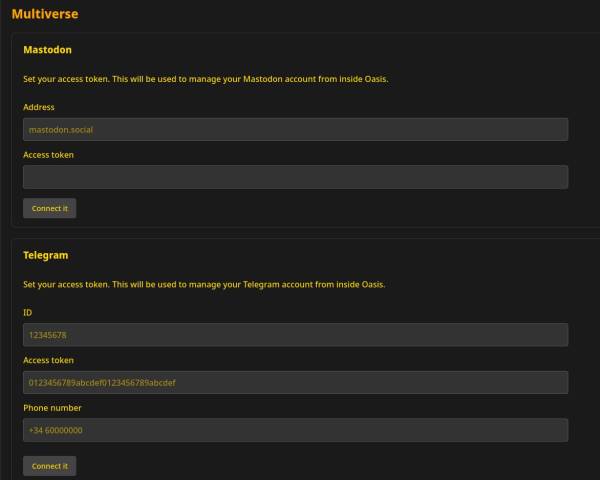
The main idea behind this implementation is to send and receive content across other networks without locking you into a single platform and without storing any third-party data in your append-only log. Your timelines and chats are fetched live and rendered on the fly, so OASIS stays light while you stay connected to the outside world.
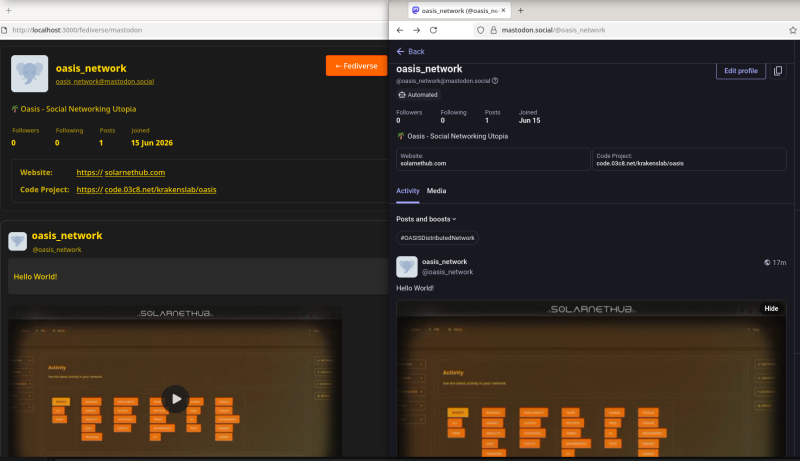
How it works
- Nothing third-party is stored: Remote posts, chats and messages are requested live for each visit and shown ephemerally. They are never written into your `.ssb` feed, so your log is not filled with other people's content.
- Local credentials only: Your access token (Mastodon) or your API hash and session (Telegram) are kept in a local, private configuration file readable only by your user. They are never published to the network, never committed to any repository, and never shown back in the interface.
- Clean disconnect: Disconnecting a network wipes its credentials from disk. For Telegram, OASIS also logs the session out on Telegram's side, so a leaked copy of the file would be useless.
- Privacy by default: Every outbound HTTP request uses the same uniform browser headers for all OASIS users, so no per-user metadata leaks and the origin is protected. Telegram is reached directly over MTProto from your node, exactly like a regular client.
- Proxied media: Remote avatars, images, videos and files are fetched through the OASIS backend with anti-SSRF protection (Mastodon) or downloaded on demand from Telegram and served locally, never linking your browser to third-party hosts. Remote HTML is always sanitized before display.
Connecting your accounts
- Mastodon: read your home timeline, publish (text, images and video), reply, boost and favourite.
- Telegram: read your chats, groups and channels, open any conversation and send messages or files.
- PeerTube: watch the videos from your subscriptions and your own, upload videos to your channel, comment, and rate them (like or dislike).
- NextCloud: with the Multiverse module you can connect your own Nextcloud and share bigger files through it.
Purpose
The Multiverse module of OASIS is not merely a Mastodon or Telegram client — it is a statement about how federation should feel from a libre, privacy-first network.
By letting you reach other networks without surrendering your data, your metadata or your attention, it treats them as peers rather than silos. Remote content stays ephemeral, your identity stays yours, and your origin stays hidden — yet you can still participate fully in the global conversation.
Ultimately, its purpose is to connect OASIS to the rest of the world on the community's own terms — sending and receiving content freely, while keeping the network light, private and humane as it grows.